
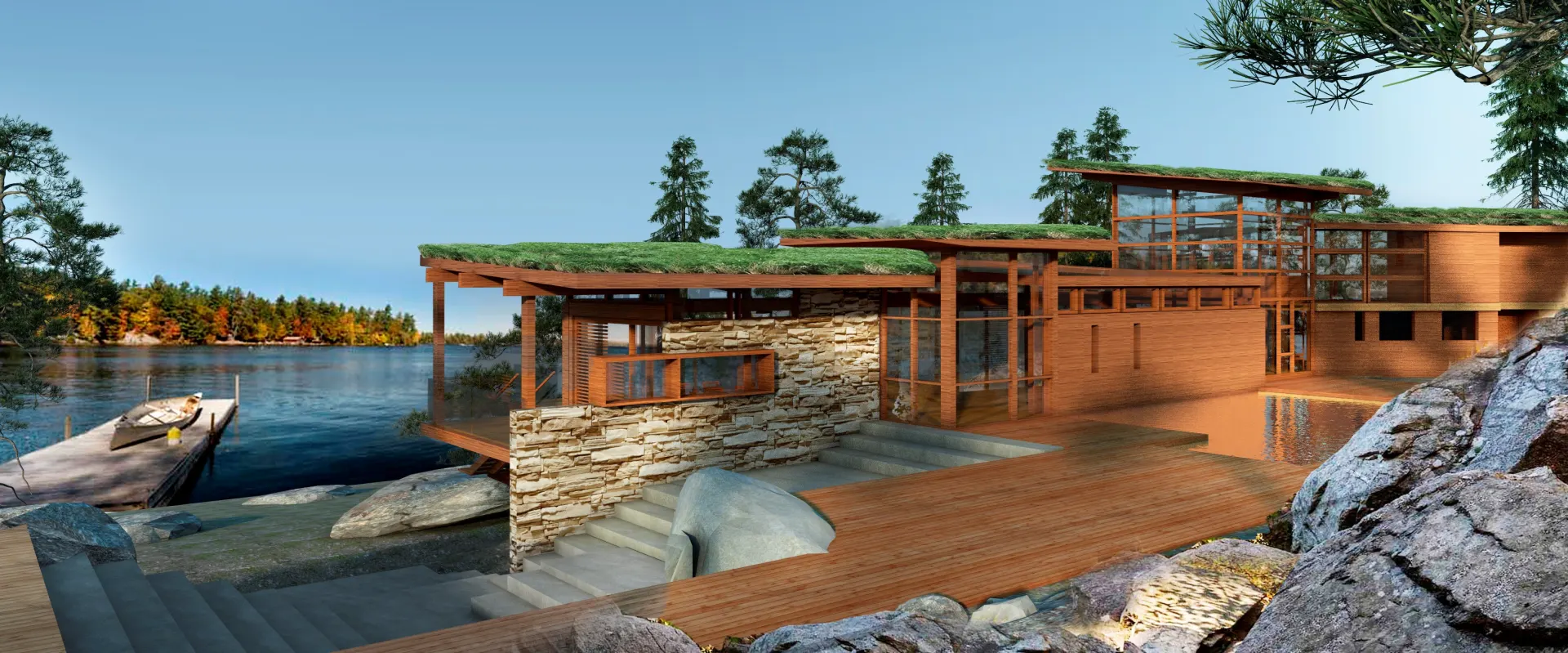
Why winter is often the right answer
Most owners assume cottage country shuts down for winter. The opposite is closer to true. Trade availability is best November to April. Heavy equipment moves over frozen ground without rutting the site. Ice roads make remote and island sites accessible to deliveries that would require barges in summer.
On a typical lakefront build, foundations land in October, shell is closed in by mid-December, and interior trades run through the deep cold months when those trades have the most capacity.
What winter does well
Framing, sheathing, and roofing once the structure is closed in and wrapped. Interior trade work, mechanical, electrical, drywall, finish carpentry, cabinetry, tile, flooring, happens inside a heated shell.
Heavy delivery: precast, structural steel, lumber packages, ICF blocks, helical pile rigs.
Excavation in some soil conditions, frozen ground holds shape better than saturated soil.
What winter does badly
Concrete pours below freezing without hoarding and heat. Possible, but every degree below 5°C adds cost and risk.
Exterior masonry, brick, and stone. The mortar will not cure properly below 4°C.
Exterior paint, stain, and most caulks. Skip until spring.
Any work that depends on a stable trade workforce traveling 90 minutes through a snowstorm at 6 AM. Some weeks the road wins.
Planning the winter calendar
Land foundation work by mid-November. Use ICF where possible, the forms are insulated and the concrete cures under controlled conditions.
Close in the shell, sheathing, roof, window install, building wrap, by December 15.
Run interior trades January through March.
Schedule exterior finish trades for April–June.
Build the deficiency walk into a separate week in late spring once exterior trades have completed.